
If you’ve been planning a trip to Osaka, there’s a good chance that you’ve seen Dotonbori listed as a place to visit. But, if you don’t know why you should go, this guide to Dotonbori will help. It’s filled with restaurant suggestions, things to do, and more.
For more tips to plan your trip, check out all our Japan posts.
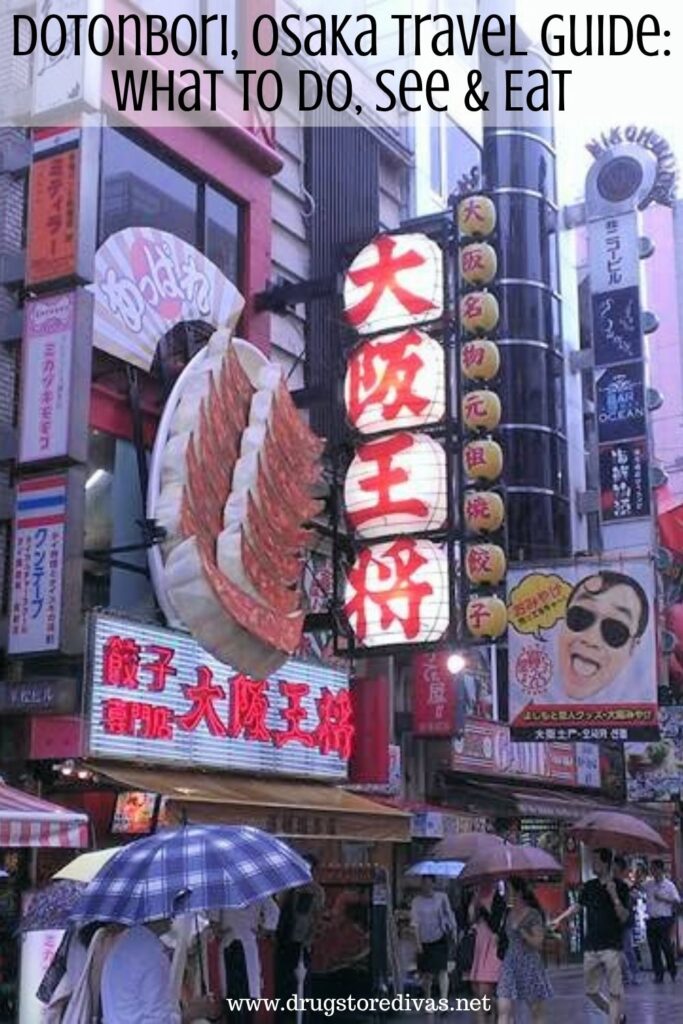
There are a few places in Japan that are really traps for tourists. Dotonbori is one of them.
It’s an entertainment and shopping district in Osaka known for the canal and large bridge that goes through the area.
We’ve been going there for decades. And, although it is filled with tourists, if you’re going to Japan and reading this, you’re a tourist. And I always say if you’re a tourist, you should do the tourist things. That’s why you’re there.
So, go to Dotonbori.
But, what are you gonna do there? That’s where this post comes in. Keep reading to find out exactly what you should look for when you visit.
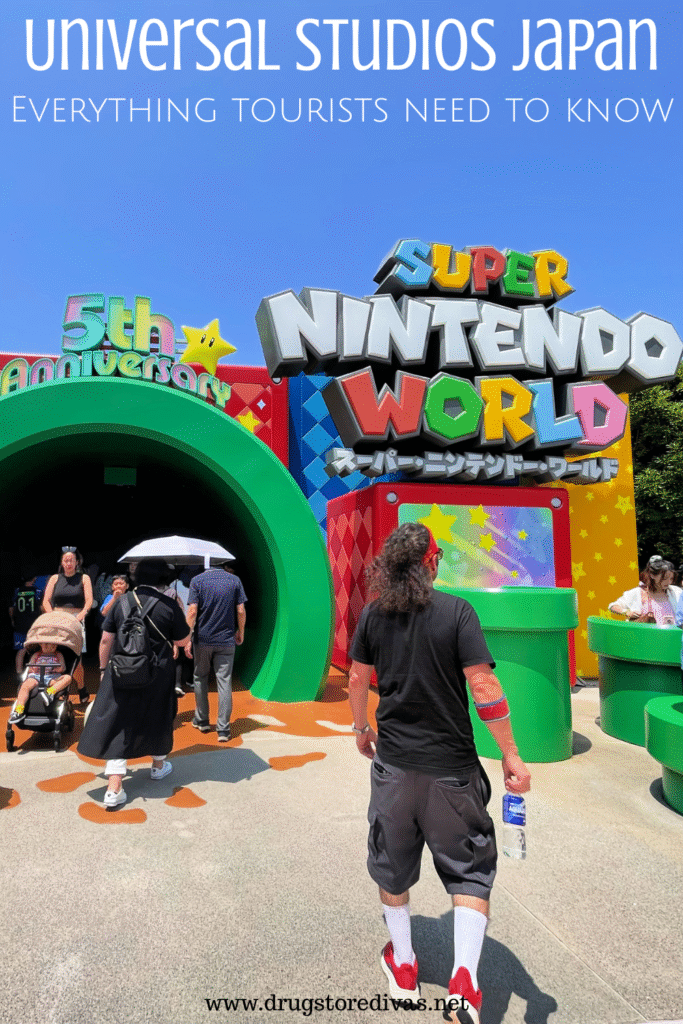
If you’re visiting Dotonbori, there’s a chance you’re looking for other things to do in Osaka. One of the most popular attractions is Universal Studios.
Find out all about it in our Universal Studios Japan review for tourists.
Dotonbori, Osaka Travel Guide: What To Do, See & Eat
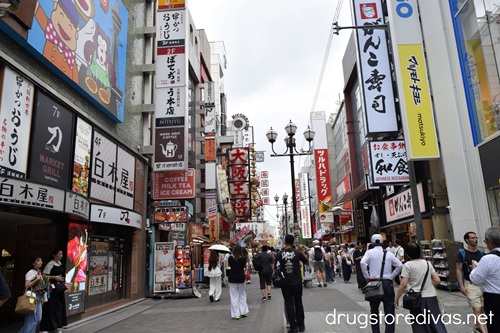
Where Is Dotonbori?
Dotonbori is a small section of the Minami district in Osaka, sandwiched between Shinsaibashi and Amerikamura, and is very close to Namba.
If you stay on Ebisubashi-suji, a straight shopping arcade, you’ll walk between all of them, finishing (or starting, depending on the way you walk) at the famous Takashimaya department store in Namba. That street runs across Ebisubashi Bridge, which is the pedestrian walkway over the Dotonbori Canal.
It’s about an hour from Kyoto by train and about 2 1/2 hours from Tokyo on the Shinkansen.
Dotonbori History
Construction on the Dotonbori Canal began in 1612. That part of the city’s history has never been disputed. But, who started and finished the construction has turned into a tall tale.
Quick version: It was begun by Nariyasu Dōton, who died in the siege of Osaka in 1615, then completed by some others later that year. That story was co-opted by lore that it was a fictional Yasui Dōton who allegedly started the canal, died in the siege, and his cousin finished it.
The canal was completed in 1621, and, shortly after, it became an entertainment hub for the city, eventually featuring kabuki and bunraku (puppet) theaters. Restaurants started popping up in the area, ready to feed the theater crowd before or after performances.
And that’s how it has remained, a huge dining and entertainment district.
Quick side note: History reclaimed the story for the original Dōton, but, as the legend goes, the Yasui family had a box reserved for them at many of the theaters, thanks to their imaginary ancestor’s legacy.
Things To Do In Dotonbori
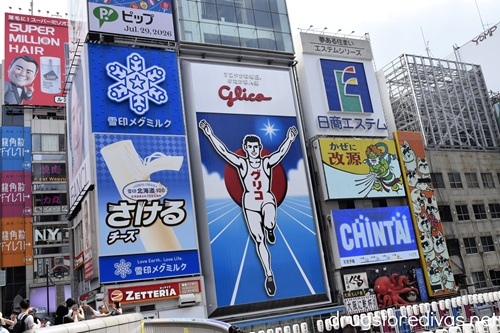
See the Glico Man Sign
There are two large chocolate brands in Japan: Glico and Meiji. Both of them have very iconic landmarks near Osaka, but only one has one in Dotonbori.
That’s the famous Glico man sign.
It has been a Dotonbori staple since its installation in 1935. The man has become the unofficial mascot of Dotonbori and any posts or videos you see about the area will feature this runner.
So, you’ll be kicking yourself if you don’t take a photo standing on the Ebisu Bridge with the Glico man behind you. If you do nothing else when you’re there, do that.
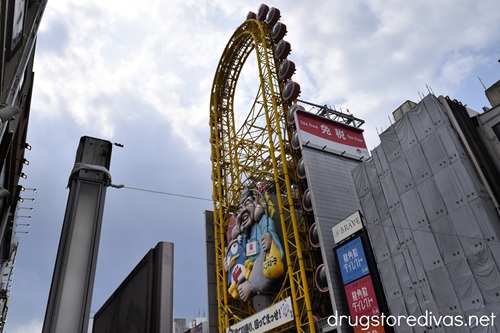
Ride the Don Quijote Ferris Wheel
The world‘s first oval-shaped Ferris wheel is the Ebisu Tower in Dotonbori. That’s its real name, but colloquially it’s known as the Don Quijote Ferris wheel because it goes around the building that Don Quijote is in. Plus, there’s a huge Donpen image in the middle.
The pods are fixed in a way that they don’t sway, but they also don’t allow you to look out in any direction besides straight. So, you don’t get the most interesting view of Dotonbori while you’re on the ride, but you do get to see some of the street’s landscape.
The Ferris wheel is down for a scheduled maintenance weekly on Tuesday mornings, but also very randomly whenever it needs maintenance during the week. Of course, when we went to Dotonbori this summer, it was down for unscheduled maintenance. It was cool to see it from the ground, though.
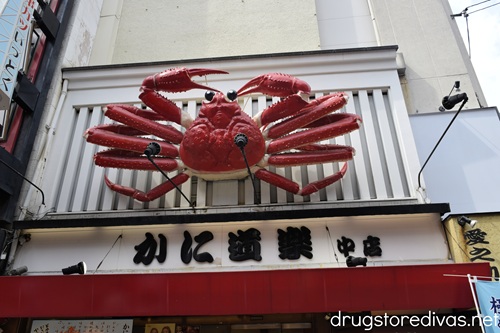
Eat At Kani Doraku
Kani Doraku is iconic. It’s known for its giant animatronic crab that sits above the restaurant’s entranceway.
Because of it, Pete and I always assumed it was like a corny Myrtle Beach-type of seafood restaurant. But you know what they say when you assume. You’re usually wrong. And we were so wrong about this.
We ate at Kani Doraku this trip (but the Juso location) and had one of the best meals of our vacation. It’s a multicourse crab tasting, with everything from crab sashimi to kani meshi. We loved the entire experience.
So, if you’re around at meal time, we highly suggest eating here. You won’t regret it. But, you’ll regret not eating here.
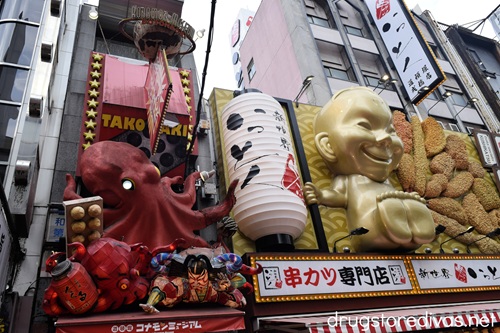
Take Photos
Dotonbori has so much to look at. It’s a big tourist destination now, but it has always been iconic. Even when it wasn’t as popular, all of the restaurants had giant animatronic and larger than life icons above their storefronts.
It’s a photographer’s dream.
So, grab your camera and be ready to shoot.
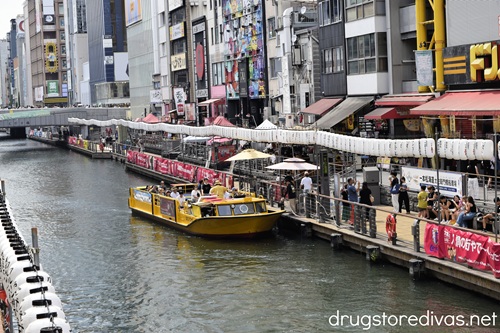
Take A Boat Cruise
If you want to see the iconic buildings from a different angle, book a river cruise. They go up and down the Dotonbori Canal while a guide gives you the history of the area.
The cruise only takes about 20 minutes, so it’s a pretty small time commitment. And sometimes, those are things you can fit in when you’re in Japan. There’s so much to do and you can’t do it all. But, if something doesn’t take that much time, you can find a way to fit it into your day
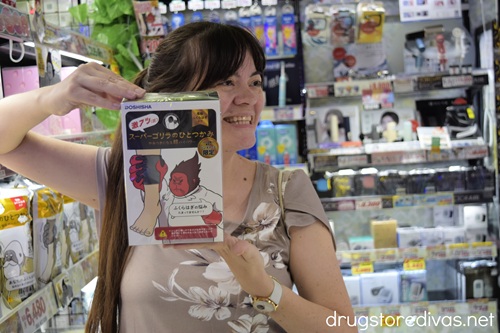
Shop At Don Quijote
Don Quijote, also known as Donki, is a large discount store filled with everything from beauty products to snacks and souvenirs. There’s so much that we actually wrote a what to buy at Donki in Japan post to help narrow your shopping down.
The Dotonbori store is arguably the most iconic because of the Ferris wheel.
The store itself has six floors for you to shop on, so definitely check it out if you have time to shop.
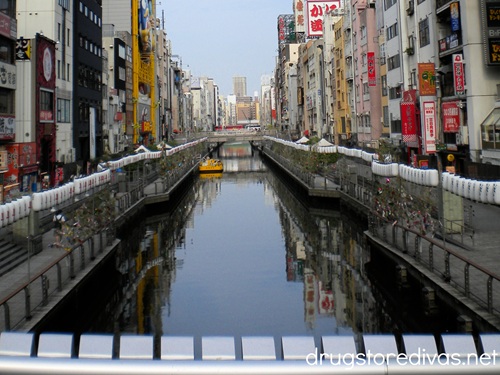
Walk Along The Dotonbori Canal
If you don’t have time to take the aforementioned boat ride, make enough time to walk along the Dotonbori Canal. It’s really easy to walk all the way up one end then walk all the way back on the other side.
You can’t walk that quick because it’s filled with tourists now and they’re all looking at the buildings and restaurants like you are. But, that’s good. That means you’ll have enough time to look up and enjoy the sights.
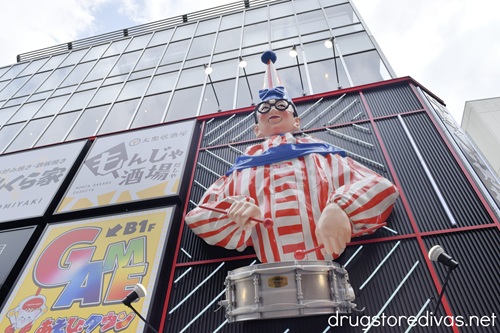
Take A Photo Of Kuidaore Taro (Or Buy His Merch)
There are a couple famous Japanese icons who you may not realize are iconic until you get home and the algorithm starts feeding you a ton of Japan posts, giving you FOMO for a trip you just took.
One of those icons is Kuidaore Taro, a mechanical drum-playing clown, created in 1950. It was originally placed at Cui-daoré, a restaurant in the Osaka Meibutsu Kuidaore building (which closed in 2008 after 59 years), enticing you in to have a meal.
That building may have closed, but he remains an unofficial mascot of Dotonbori.
He’s now at the entrance of the Nakaza Kuidaore Building. The first floor is an Osaka souvenir store, which sells official merch including everything from keychains to socks to Kuidaore Taro pudding in packaging that looks like Taro’s hat.
There’s a giant version of him on the front of the building, so if you’re looking up, you won’t miss it.
Eat Some Street Food
Osaka is known as a food mecca, and, once you visit, you’ll know why
This time, when I came home and people asked how my trip was, my first comment has been: I ate everything I wanted.
There’s so much Japanese food, especially street food, that I crave because I can’t get it or get that quality in America. So, when I’m in Japan, I eat. And, when you’re in Dotonbori, you should too.
I will forever be obsessed with Kani Doraku. It’s one of those experiences that will be ingrained in my mind forever.
But, maybe you don’t wanna go there. Maybe you don’t like crab. That’s totally fine. There are so many other foods to eat in Dotonbori.
Look for foods like takoyaki, which you can grab and eat quickly before continuing on your walk. Because remember, in Japan, you can’t walk and eat. So, look for small portions of street food or something like yakitori, which is a single skewer, that you can enjoy quickly before getting on your way.
Go Back At Night To See The Lights
Dotonbori is fine during the day. It looks like a crowded, touristy, shopping street.
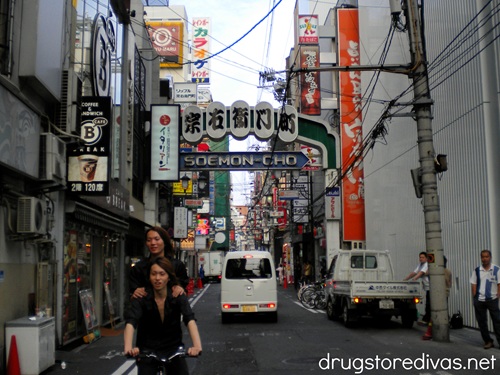
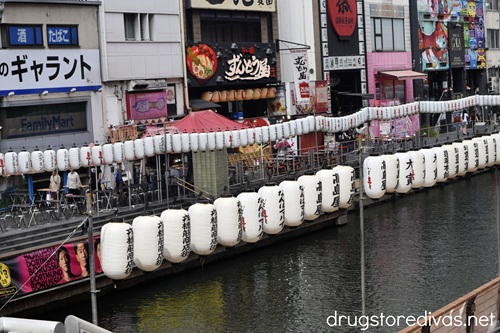
But at night, it’s a very hip and cool area. Everything is lit up, the signs on the shops and restaurants (and the signs at the end of the streets that tell you that you’re in Dotonbori) are bright, and the lanterns along the Dotonbori Canal are illuminated.
The entire vibe feels more electric. You can absolutely tell then why people refer to Dotonbori as Osaka’s Times Square.
So, if you’re in the area and you have a little extra time, go back at night. It’s a different experience and you’ll be glad you went back for it.
Famous Restaurants In Dotonbori
Dotonbori has been a popular spot for restaurants for years, so of course, it has attracted long-standing chain restaurants that have been around for decades.
If you want to go to those, five of the most popular are:
- Hariju: The sukiyaki and shabu-shabu restaurant is located at the entrance of Dotonbori and has been there since 1948, although its history dates back to when businessman Kizo Fujimoto opened his first restaurant in 1919.
- Imai: The noodle shop (specializing in udon and soba) opened in 1946. It’s in a traditional Japanese-style building, which is a stark contrast from the modern feel of Dotonbori.
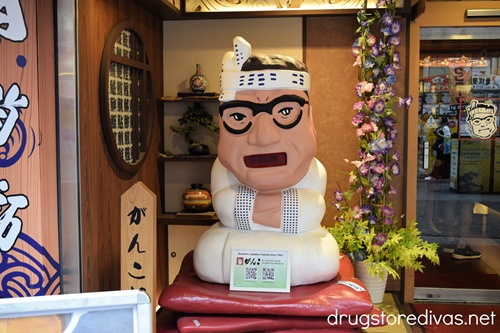
- Ganko Sushi: The chain began in 1963 in Juso (the town where we had Kani Doraku), opened in Dotonbori the following year, and currently has over 100 locations worldwide. There’s a giant Ganko Oyaji (pictured above) welcoming you to the Dotonbori location.
- Kani Doraku: A multi-course crab restaurant known for its animatronic crab on the building. The restaurant was originally opened in 1960 in Dotonbori (and has over 40 locations around Japan now).
- Kinryū Ramen: A huge dragon sits atop each of the three Dotonbori locations. It was opened in 1982 and is one of the few 24-hour restaurants in the area, perfect for late night meals.
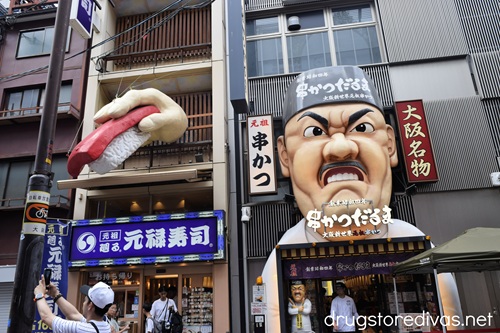
- Kushikatsu Daruma: A restaurant serving kushikatsu (deep-fried skewers of meat or vegetables), famous for its angry chef mascot. The restaurant originally opened in Shinsekai in 1929.
How Long Do You Need In Dotonbori?
Although there are a ton of shops and restaurants, Dotonbori is a pretty small area that’s just a total of nine blocks.
You can walk it in about 10 minutes (without stopping), but we suggest blocking off about two hours to do the whole thing. That gives you enough time to shop at Don Quijote, check out a restaurant or two, and marvel at all the famous 3D storefronts.
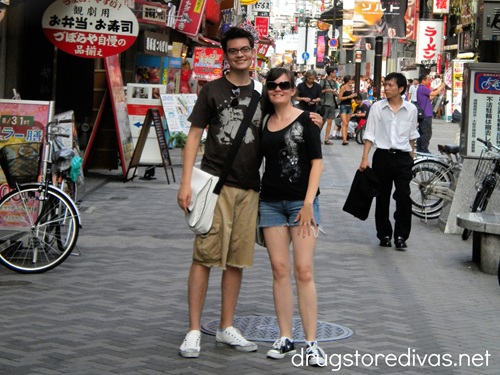
Visitor Tips
Getting there
There isn’t a train stop at Dotonbori itself, so you’ll want to take a train to Namba and walk to Dotonbori. Just be careful about using your GPS within the Namba station. It’s really large and the GPS has trouble with multiple levels. Instead, use your eyes to look for signs to exit the station, and start your navigation when you’re above ground.
Best time to visit
Dotonbori is going to be crowded no matter when you go, so the best time to visit is really when you have the time to go. But, it also depends on the atmosphere you want. If you want to go to eat street food and shop, go around the late afternoon/lunchtime. If you want to experience some of the nightlife, go after sunset so you can see the street and canal when it’s illuminated.
What to wear/bring
We’ve been to Dotonbori in the summer when it’s very hot and we’ve been on days when it’s raining and everyone is carrying around umbrellas. So, what to wear and bring depends on the weather that day.
We do suggest wearing sneakers though, especially if you’re planning to walk around the area.
Since you’ll be outside, we do suggest wearing sunscreen for some protection. Dotonbori itself is mostly uncovered and you don’t want sunburn. The shopping street you take to get there is covered, though.
We also suggest you bring your patience because it is crowded and if you want that perfect shot with the Glico man, you’ll have to wait for everyone else who wants that photo too.
Small aside: If you’re planning a trip to Japan, our Japan packing list can make sure you have everything you need, not just for Dotonbori but for your whole trip.
Things To Do Near Dotonbori:
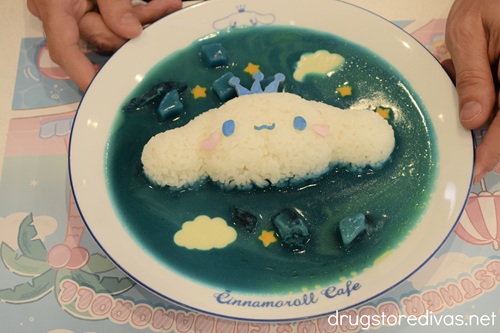
Since Dotonbori won’t take all day, you’re probably trying to look for other things to do in the area. One of our favorites is visiting Cinnamoroll Cafe in Namba. If you’re a Sanrio fan, it’s a must do.
Namba also has a ton of shopping with stores like Daiso and Onitsuka Tiger, plus traditional shops.
You could also hang out in Amerikamura, a town based on American hip hop and street culture. You’re also really close to Shinsaibashi, which is filled with shopping and food.
Have you been to Dotonbori? Comment below and let us know your favorite things to do there.